
2026-08-15
Read Case
Case Brief: Cross-Functional Knowledge Preservation
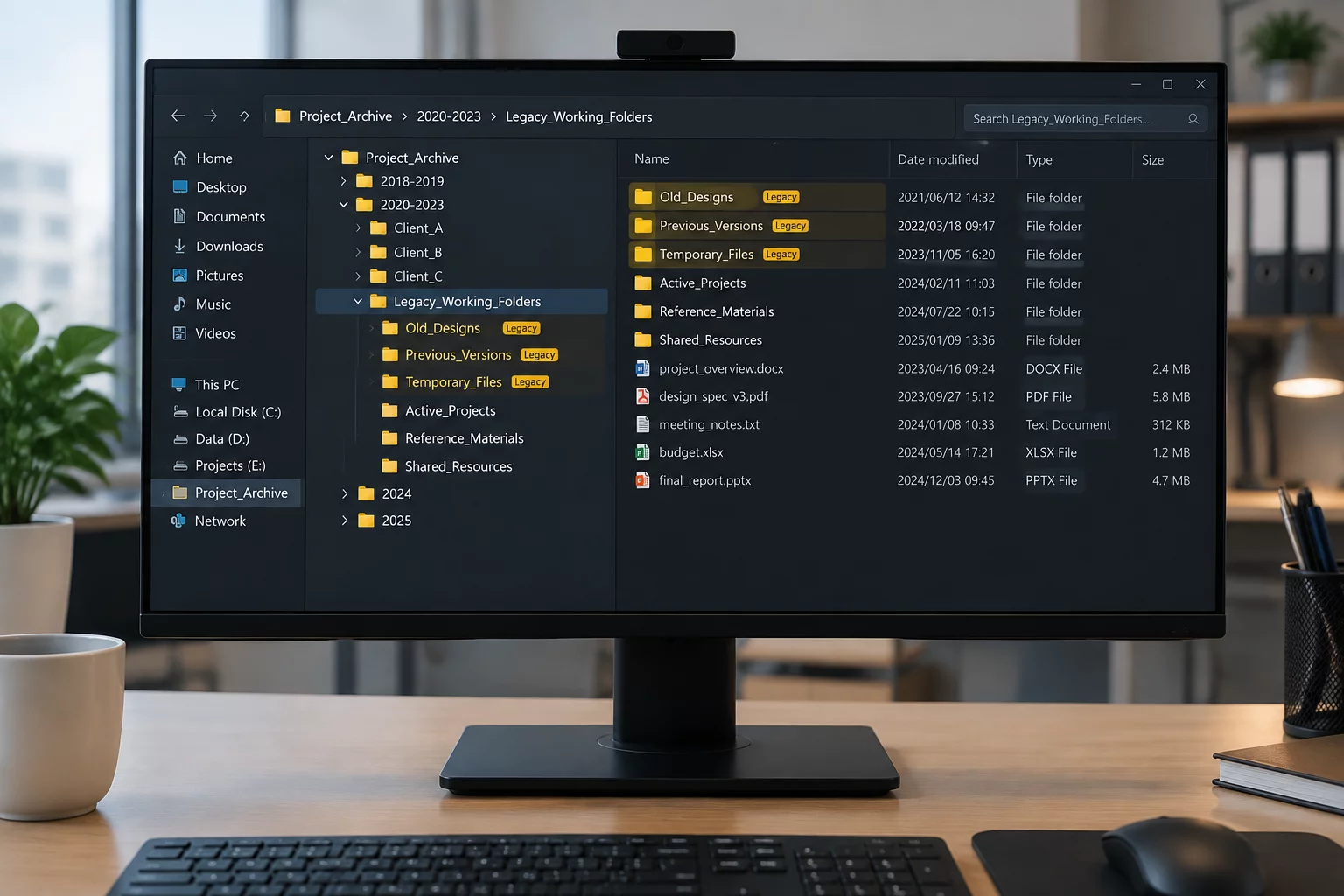
When Team Orion concluded their customer journey analytics initiative, standard protocol dictated archiving their workspace into read-only repositories. Three quarters later, the newly formed Retention Group faced identical architectural challenges. Because Orion practiced systematic project archive organization with detailed schema definitions, the Retention Group recovered months of foundational research without duplicating effort or bothering departed team members.
14 Weeks
Engineering Time Saved
100%
Schema Reusability
Zero
Owner Dependency Delay
48 Docs
Preserved Artifacts

Cross-functional team leads examining legacy repository schemas and structural query trees during knowledge transfer.
LOG-SEC-8821
1
Phase 1: Project Closure
Orderly Deprecation Over Silent Abandonment
Most initiative lifecycles conclude with a celebratory release meeting followed by immediate abandonment of the working directory. In Orion's case, their lead architect instituted a rigorous project archive organization sprint. Instead of leaving unindexed SQL transformations across local drives, the team consolidated completed-project materials into a unified, versioned directory.
They cataloged raw dataset schemas, validation scripts, and query benchmark results. Each artifact received standardized metadata explaining dependencies, licensing constraints, and edge-case exceptions encountered during production rollout.
- Structured directory indexing separating draft research from production-tested logic.
- Comprehensive environment configuration notes enabling deterministic sandbox rebuilds.
Decision Matrix
Cross-Departmental Archive Governance
Discover architectural protocols that convert dormant repositories into discoverable assets for adjacent squads facing similar operational requirements.
2
Phase 2: The Knowledge Gap
When Internal Turnover Erases Institutional Context
Eight months after Orion disbanded, the company experienced substantial project ownership changes across engineering leads. When the new Retention Group received requirements to analyze customer lifetime value, none of the original data architects were available to provide verbal guidance.
Without documented context, engineering squads frequently rebuild existing infrastructure from scratch, assuming legacy repositories are broken or incomprehensible.
Archival Risk Breakdown
Recreating complex data aggregation pipelines from zero would have consumed an estimated fourteen engineering weeks and $180,000 in redundant cloud compute experiments.
Because the Orion archive contained readable commit records and architecture decision records, the Retention Group identified that 85% of the data ingestion pipelines were directly transferable to their new charter.
3
Phase 3: Archive Discovery
Seamless Handoff via Long-Term Document Organization
The discovery occurred through centralized metadata search rather than hallway conversations. The new team searched for specific retention event schemas and immediately located Orion's repository with complete lineage maps.
Applying disciplined long-term document organization transformed what could have been a dead digital graveyard into an active springboard. The squad cloned the sandbox environments within twenty-four hours and ran benchmark tests against modern datasets.
- Clear operational boundaries distinguishing validated production schemas from experimental branches.
- Explicit documentation of abandoned hypotheses preventing the new team from repeating past failures.
4
Phase 4: Long-Term Value
Institutional Memory as an Operational Multiplier
The Retention Group delivered their first production milestone six weeks ahead of schedule. More importantly, they updated the archival record, appending their modern findings to the Orion foundation for future squads.
Preserving institutional documentation is not merely housekeeping; it represents an active investment in cross-team acceleration and resilient knowledge continuity across corporate growth cycles.
Clarifications & Insights
Frequently Asked Archival Questions
Case Archives
Browse Full Archive
Related Post-Project Studies


Peer Commentary
Active Thread
Archival Review Debriefs
Submit Archival Feedback
Contribute your analysis to this project record preservation log.
To leave a comment, please log in to your account.
No archival debrief comments recorded yet. Be the first to submit observations on this project record.